The “box-in-a-box” principle, in which the walls of the recording studio, as well as its floor and ceilings, are independent of other building structures and are not rigidly connected to them, has proven to be a good practice. A separate foundation is used or special spacers are placed between the box floor and the ceiling. Your garage doors should be intact and working, if you have problems with your garage doors, you can contact A Plus Garage Doors they will make you emergency door repairs. The modular principle of arrangement makes it possible to fit a recording studio into a larger room, providing it with soundproofing due to the multilayered enclosing structures.
It is also possible to build on additional wooden or metal frame on walls that are rigidly fastened to the main wall and soundproofing materials are mounted on them. Metal profiles are much more convenient in terms of installation, but they have a serious drawback – with strong vibrations they begin to “ring”, which is unacceptable for the recording studio. Therefore it is necessary to additionally lay metal profiles with soundproofing material or connect them with assembly foam to the wall to transfer vibrations to the wall.
Interior finishing of the recording studio
The interior finish of the studio must have a sufficient number of sound absorbing and sound dissipating structures. For sound absorption, mineral wadding wrapped with glass wool is used which is inserted into the cells of supporting wooden frame and covered with decorative, acoustically transparent covering, for example, wooden battens. Sound-scattering constructions are made in the form of prisms and pyramids of plywood or plaster. Place such structures on the ceiling.
Soundproofing of the wall is laid out on the principle of a “sandwich”. As a base, filling the space between the wall and the framework, a soundproofing material with a high degree of absorption of low frequencies is required. For this purpose, “wool” is very well suited. But do not stuff the walls with medical wool, it will be of little use. After all, we have a recording studio, not the sanitary rooms. There is a special acoustic rock wool or mineral wool. Strangely enough, but rock wool, it really is “stone”, ie made of stone, and therefore is absolutely fireproof. Plus rock wool has very good thermal insulation properties, which means your recording studio will be warm on cold winter evenings.
A list of necessary materials depends on the task in hand, but for all types of soundproofing works the following general points can be made:
- Trussing (wooden bars or metal wall and ceiling profiles);
- repair garage door
- Sound-absorbing material (a fairly broad concept, including both roll and sheet materials and poured foam insulation);
- Cladding material (from gypsum board to OSB boards);
- Scotch tape;
- Fasteners (mostly hardware, in some cases plastic umbrella dowels);
- Mesh gauze (under-plastering reinforcing mesh made of fiberglass);
- Decorative and adhesive mixes and other materials for finishing (wallpaper, paint, protective impregnation and primer).
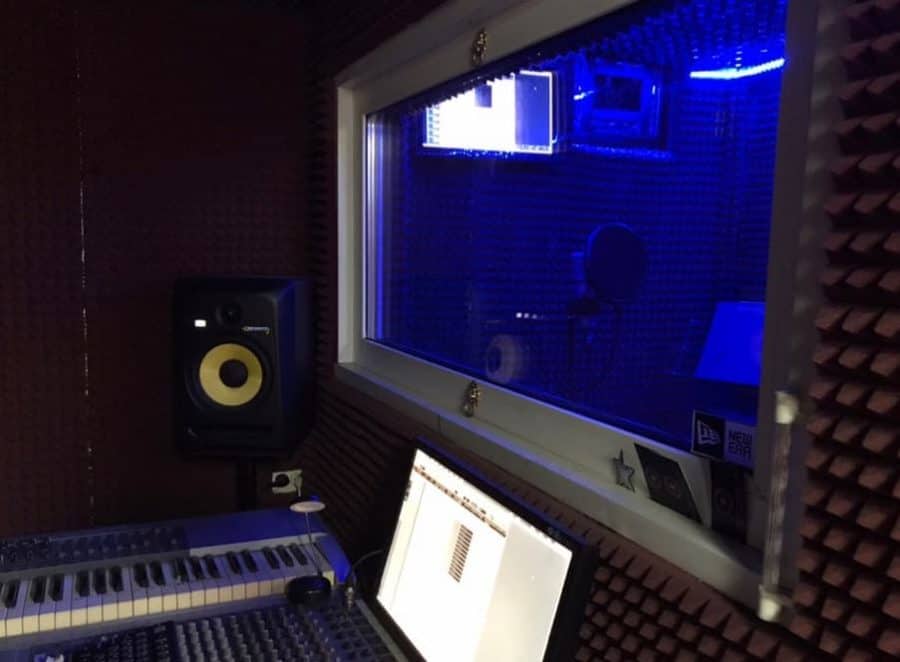
Soundproofing in the garage
But there is one “but”. If you do not want your lungs after 5 years have turned into “mincemeat”, then we strongly recommend that you first use rock wool, not mineral, and secondly always close the wool next layer of sound insulation, so that nowhere were open areas of wool (even the smallest 1cm to 1cm). Otherwise, when the drummer will hit the drum through this hole, the wool fibers will fly out, get into the lungs and as a result – “mincemeat”. About the safety of the installation of soundproofing wool is not even worth talking about. Masks, respirators, gloves, goggles, etc. – just have to. Take care of your health.
It is important that the sound isolation of recording studios does not overload the sound, does not make it “dead”. Acoustic balance can be achieved with a combination of porous, membrane and perforated absorbers. Membrane absorbers, such as wool, are used to absorb low frequencies. They are independent of wavelength, so they are effective at 150-200 mm thickness. Perforated absorbers absorb mainly medium and high frequencies. Porous absorbers absorb low, medium and high frequencies.
For absorption of medium frequencies, acoustic soundproofing plasterboard is well suited. Its peculiarity and the main difference from conventional drywall is that the acoustic drywall is evenly riddled with holes. Sound is not reflected from it, and falls into the holes and through them – into the wool, where it is safely extinguished. Such drywall is covered with dense paper tape on the back side, which does not allow the wool to “fly out” through the holes and spoil your health. But the installation of such drywall is a delicate matter, it is much more fragile than conventional drywall, so be gentle and gentle with it.
As soundproofing for the recording studio is effective method of “checkerboard”. At a distance of 10 cm from the wall is mounted wooden frame of timber (section 30×100 mm) and filled with a ten-centimeter layer of acoustic foam. Half of the cells in staggered order is closed with perforated fiberboard sheets with a thickness of 3-4 mm. The diameter of the holes – 3 mm in increments of 38 mm. The method is particularly good in rooms for vocals and listening to musical instruments. Allows you to eliminate the effect of an aechoic (“cotton”) room at high frequencies.
Budget variant of noise insulation for a temporary garage
In order to provide relative soundproofing in a temporary metal or wooden garage, it is possible to cover it from the inside with any material, except, perhaps, PVC and MDF panels.Soundproofing in a garage soundproofing
And the crate, in the traditional form, is not necessary. Vertical wooden bars on the walls (with a pitch not exceeding the size of the finishing material) and parallel to them, bars on the ceiling of the garage, sewn up, and the resulting voids are filled with liquid foam plastic, through technological holes in the roof.
The ventilation issue is solved by equipping the offset channels of flat plastic boxes.
According to the statements of manufacturers, 50 mm layer of liquid foam plaster competes with 125 mm layer of mineral wool, and, both from the point of view of heat, and sound insulation. In addition to the main purpose, this solution allows you to effectively protect the temporary box from damage during transportation.